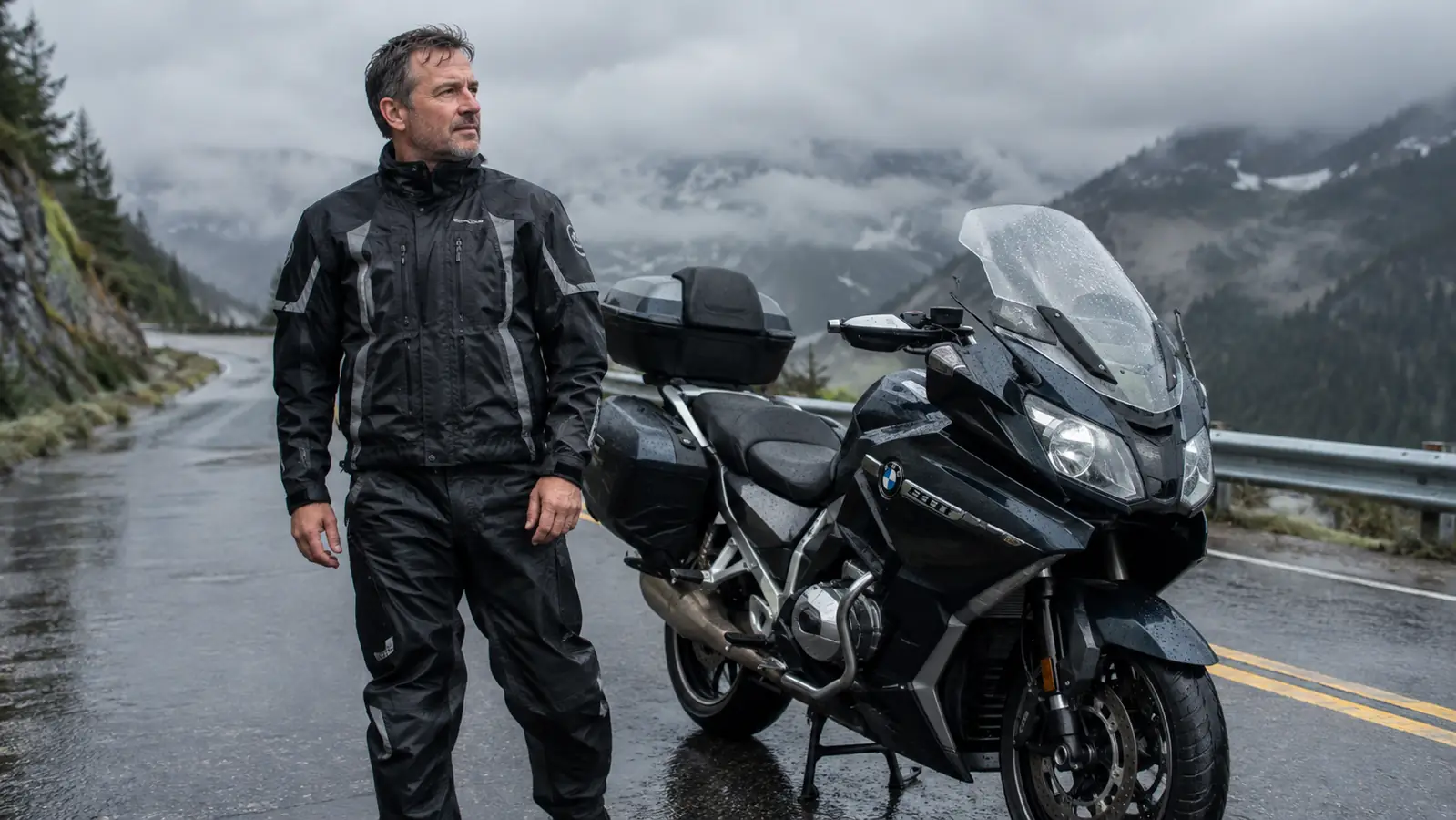
Here is the honest version, the one nobody puts on the box. I bought the Nelson-Rigg Stormrider rain suit last spring because I got caught in a sleet storm on the Cascades Highway in May and swore I would never do that again. I am 58, I ride a 2017 Honda Gold Wing, and I live outside Bend, Oregon, where the weather does not ask permission. Six months and about 4,000 miles later, including one downpour that would have soaked a seal, I can tell you exactly what this suit does, what it fumbles, and whether the money is worth it.
The short answer: it kept me dry when it mattered, it packs down to almost nothing, and it has three flaws you will not read about in the marketing. The zippers are finicky, the collar sits awkwardly under a helmet, and the fit runs generous in a way that can catch wind at highway speed. None of those are dealbreakers. All of them are worth knowing before you hand over your card.
The Quick Verdict
The Nelson-Rigg Stormrider is the best packable rain suit I have owned in thirty years of riding. It is not perfect, and the flaws are consistent enough that you should know them before buying. But for the rider who wants to carry real weather protection without living in it, this is the one.
Amazon Check Today's Price →Carry real rain protection without hauling a suitcase
The Stormrider rolls down smaller than a loaf of bread and fits in a saddlebag. If you ride where the forecast lies, this is the suit to have along.
Amazon Check Today's Price on Amazon →How I've Used It
I did not test this suit in a controlled environment. I wore it the way a real rider wears rain gear. It went on in gas station parking lots, on the shoulder of Highway 97 when the sky opened, and once in a friend's barn near Sisters while hail bounced off the roof. I wore it over a perforated leather jacket and over a mesh jacket with a liner. I wore the pants over jeans and over textile riding pants. I rode in steady rain for three hours, in stop-and-go drizzle for a full day, and in one 45-minute cloudburst that had cars pulled over with their hazards on.
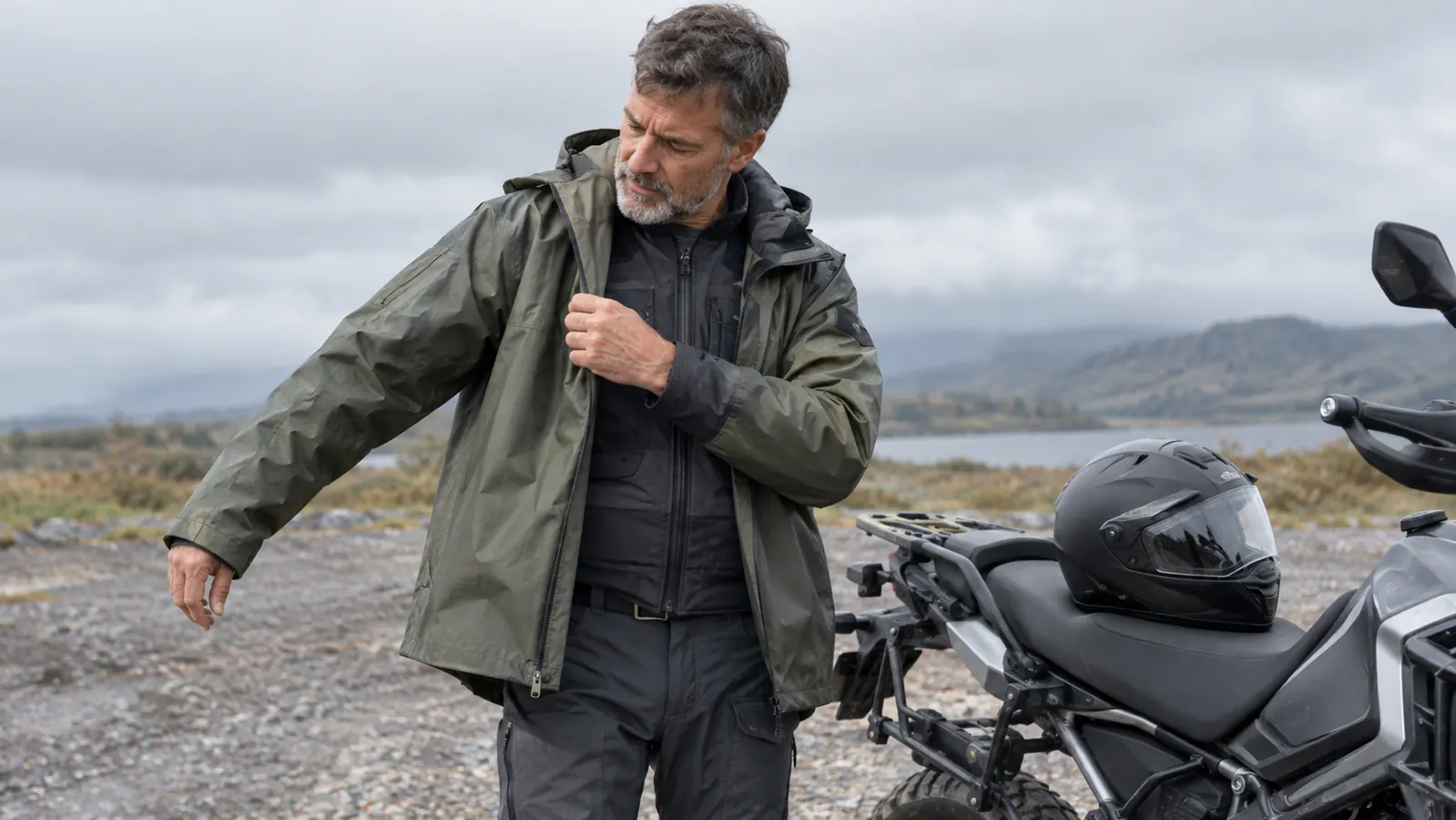
The suit is a two-piece set: an anorak-style jacket that pulls over your head and bib-style pants that go on over your boots. That pullover design is the first thing most riders notice, and it is worth understanding before you buy. You cannot throw the jacket on like a normal coat. You have to pull it over your head, which means taking your helmet off, and if you are already wet, that is a cold thirty seconds. I learned that lesson on a June morning outside a diner in Redmond, standing in a light drizzle with my helmet tucked under my arm while I wrestled the jacket over my head. It took me about a minute and a half, and by the time I had it on, my shoulders were damp. The second time, I put the jacket on before I strapped the helmet, and the whole thing took twenty seconds.
The tradeoff is that a pullover has fewer places for water to get in. No front zipper means no front zipper to leak. Nelson-Rigg knows exactly what they are doing here, and after a full season I understand why they chose it. The suit is built around a simple idea: fewer openings, fewer failures. The jacket has a long chest zipper that runs from the collar down to about the sternum, which helps you get it on and off without fully committing to the pullover dance, and that zipper is the one I have to be careful with. It is the same stiff zipper as the rest of the suit, and it is the one that catches fabric most often.
What Nobody Tells You About the Fit
Here is the thing the reviews leave out. The Stormrider fits big. I am 5-foot-10 and about 195 pounds, and the large is loose on me even over a heavy riding jacket. That is not necessarily bad. Rain gear needs room for air to move, and a snug rain suit is a sweaty rain suit. But it means you should think carefully about sizing, and if you are between sizes, the smaller one is probably the right call. I measured the jacket across the chest one afternoon out of curiosity: it is a full 54 inches around at the armpits, which is about two inches more than my regular riding jacket in the same labeled size.
The loose fit shows up at speed. At 65 or 70 on the highway, the jacket flaps. The fabric is not heavy enough to stay put, and the elastic at the cuffs and waist only does so much. It is not dangerous. It is just noisy, and after two hours it gets old. On a stretch of US 20 heading toward the coast last August, I rode into a headwind for about an hour and a half, and the flapping was loud enough that I could hear it over the Gold Wing's fairing. I stopped at a rest area and snugged the waist elastic, which helped some, but the sleeves still drummed against my arms. If you do most of your riding under 55, you will barely notice. If you tour at interstate speeds, factor that in.
The pants are a different story. The bib style means they stay up without a belt, and the ankle zippers are long enough to get over boots without a wrestling match. The suspenders are adjustable, and once you set them, they stay. My one complaint there is that the leg openings are wide, which is great for getting them on and less great for keeping water from running down into your boots. Tuck them into your boots or use the elastic loops on the bottom. The loops work. Use them. I did not use them on the first ride, and I came home with wet socks. I have used them on every ride since, and I have not had a wet sock in five months.
I rode through a 45-minute cloudburst that had cars pulled over with their hazards on. When I got home, my shirt was dry. That is the whole review.
The Zippers Are the Weak Point
I want to be fair here because the rest of this suit is genuinely well made. The zippers are the one place where the Stormrider feels like a budget product. The main zippers on the jacket and pants are waterproof-style, but they are stiff, and the pulls are small. With gloves on, which is how you will actually use this suit, they are hard to grab and harder to seat. I have had the jacket's chest zipper catch on the fabric at least a dozen times. On a cold morning in October, I stood in my own driveway for a full four minutes trying to get that zipper seated, and I finally had to take my gloves off to do it. That is the kind of detail that does not show up in a spec sheet.
There is a trick that helps. Zip with the suit on, not before you put it on, and pull the fabric taut with your other hand so it does not bunch. That works about 80 percent of the time. The other 20 percent, you will stand in the rain fiddling with a zipper while your riding buddy waits. It is not the end of the world. It is exactly the kind of thing a 4.4-star product with 4,900 reviews has that a 5-star product with 300 reviews does not. The zippers have not failed on me, and they have not leaked. They are just the least refined part of an otherwise well-thought-out suit.
How Dry Is Dry, Really
The Stormrider is rated waterproof, and in my experience that rating is honest. The fabric is a coated nylon that does not wet out the way some breathable membranes do. Water beads and runs off. After three hours of steady rain, the outside was soaked and the inside was dry. Not damp. Dry. My base layer, my mid layer, and my jeans were all dry when I got home. That three-hour ride was on a September afternoon between Bend and Prineville, and the rain was steady the whole way, the kind of rain that soaks through a mesh jacket in about ten minutes. The Stormrider never even dampened the shoulders of the jacket underneath.
The one place water found its way in was the collar. The jacket has a hood that stows in the collar, and the collar itself sits higher than most. Under a full-face helmet, it bunches and leaves a gap at the back of the neck. In the big downpour, I got a thin trickle of water down my back. It was not a flood. It was a leak, and it happened in exactly the spot I would have predicted if I had thought about it. The hood, when stowed, creates a lump of fabric right at the nape of the neck, and that lump is what the helmet pushes against, opening a channel for water.
The fix is simple and cheap. Wear a neck gaiter or a bandana, and tuck it into the collar. I started doing that after the second ride and have been dry ever since. If you ride without a neck covering, buy one. It turns the Stormrider from a 90 percent suit into a 99 percent suit. I keep a plain cotton bandana in the same saddlebag as the suit, and it takes up no more room than a folded handkerchief.
Packability Is the Real Superpower
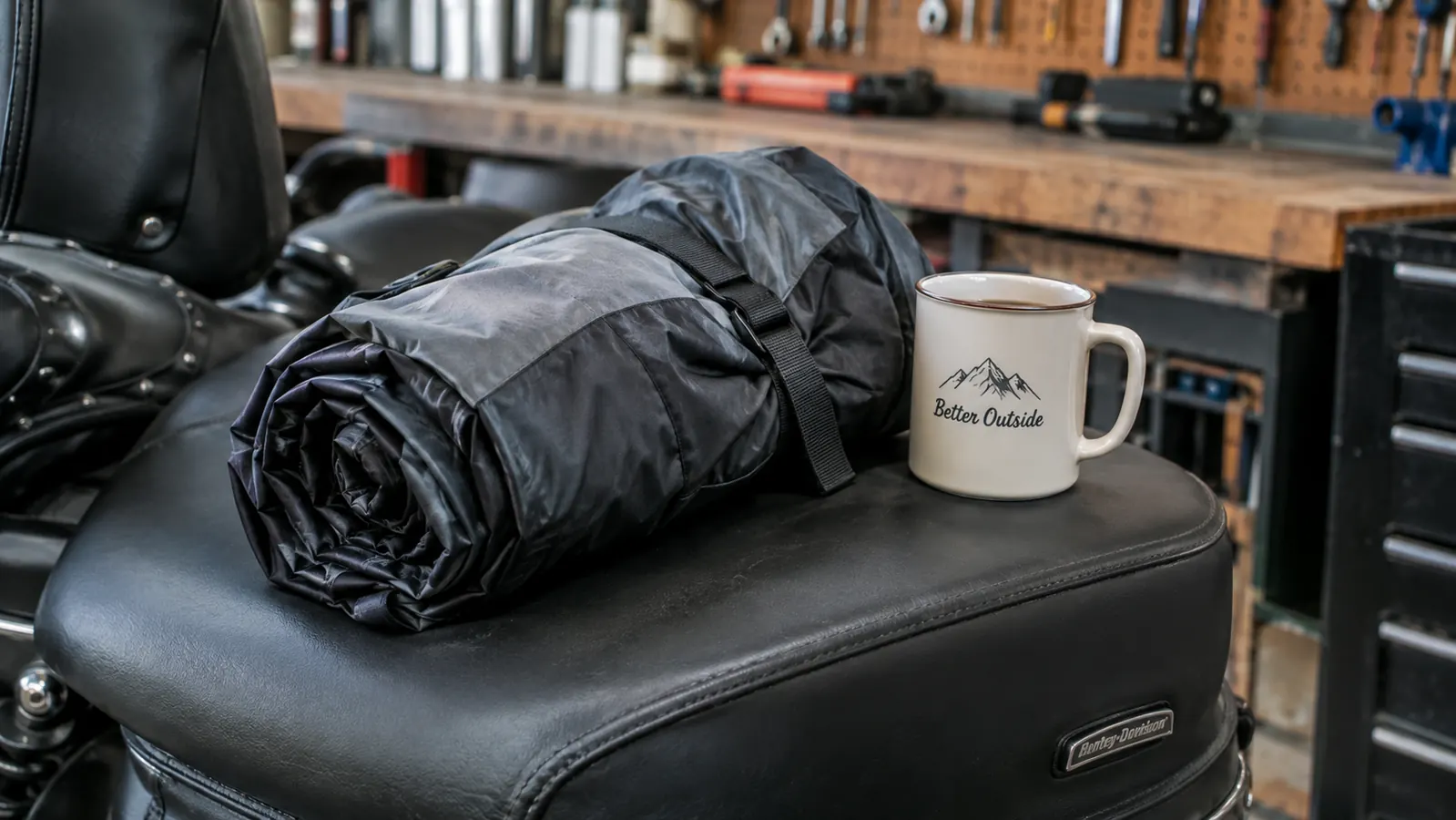
The reason I carry the Stormrider every day, even in July, is that it takes up almost no room. The whole set rolls into its own built-in pouch, and the pouch is about the size of a loaf of bread. It fits in a saddlebag with room left over for a tool roll and a first-aid kit. On the Gold Wing, space is not exactly scarce, but I also commute into Bend, and I do not want to haul a bulky rain suit around town all summer. I measured the rolled pouch one day: it is roughly 12 inches long and 6 inches across, and it squishes down another inch or two when you compress it.
It is also light enough that you will not notice it in a backpack. I weighed it once on the bathroom scale and it came in around three pounds. For comparison, the heavy-duty PVC suits I used in my twenties weighed twice that and took up four times the space. The Stormrider is not a suit you leave at home because it is too much trouble. That is the whole point, and it is the reason I actually have it with me when it rains. On a July trip to the high desert, I carried it for four days and never took it out of the pouch. On the fifth day, a thunderstorm rolled over the pass, and I was the only rider on the road who pulled over, suited up, and kept going dry.
What It Is Not Good At
I want to be direct about this because the marketing will not tell you. The Stormrider is not a cold-weather suit. It is a rain suit. The fabric is uninsulated, and while it does block wind, it does nothing to keep you warm. If you ride in 40-degree rain, you need layers underneath, and you need a lot of them. I have worn it over a heated liner, and that combination works. The suit alone in cold rain will leave you shivering within an hour. I found that out on a 38-degree morning in late October, when I wore the Stormrider over a flannel shirt and a thin sweater and was cold by the time I reached the highway.
It is also not a suit for all-day wear in heavy rain. The coated nylon does not breathe the way a high-end Gore-Tex suit does. You will sweat if you wear it for hours in mild weather, and sweat is its own kind of wet. For a commute or a day trip, that is a fair trade. For a week-long tour in constant rain, you would want something with better breathability and a higher price tag. I have worn the Stormrider for a full day of on-and-off rain, and by evening the inside of the jacket was damp from perspiration, not from rain. That is the honest tradeoff of a packable suit.
What I Liked
- Genuinely waterproof in sustained rain, not just drizzle
- Packs down smaller than any rain suit I have owned
- Pullover design means one fewer zipper to leak
- Bib pants stay up without a belt and go on over boots
- Elastic loops on the pants keep water out of your boots
- Honest price for the level of protection
Where It Falls Short
- Zippers are stiff and hard to use with gloves
- Collar bunches under a helmet and can leak at the neck
- Loose fit flaps at highway speed
- Not breathable enough for all-day wear in warm rain
- No insulation, so cold rain requires serious layering
Who This Is For
The Nelson-Rigg Stormrider is for the rider who wants to be ready for rain without living in rain gear. It is for the commuter who gets caught in a squall on the way home. It is for the tourer who wants a spare set in the saddlebag for a mountain pass that turns ugly. It is for the rider who has owned a cheap poncho, watched it flap to pieces at 60 miles an hour, and wants something that actually works. It is for the rider who, like me, has been caught once too often on the wrong side of a mountain and decided that the next time, the gear would be in the bag before the weather turned.
It is also for the rider who hates the feeling of carrying gear they never use. Because this suit is small enough and light enough that carrying it is a non-event, you will have it when you need it. In my experience, that is the single biggest factor in whether rain gear does its job. The best rain suit in the world is useless in the garage. I have owned three rain suits that were too bulky to carry, and I left all three at home on the exact days I needed them. The Stormrider is the first one I have owned that I do not have to think about.
Who Should Skip It
Skip the Stormrider if you ride in cold rain every day and need a suit that doubles as insulation. That is not what this is. Look at a lined, breathable suit with a real membrane and pay twice as much for it. Skip it if you are between sizes and want a snug fit, because the Stormrider runs generous and the flap at speed will annoy you. Skip it if you have limited hand strength, because the zippers really are stiff, and fighting them in a downpour is no fun.
And skip it if you expect perfection at this price. The Stormrider is a well-made, thoughtfully designed piece of gear with three consistent flaws. If you go in knowing about the zippers, the collar, and the loose fit, you will be happy. If you go in expecting a premium suit at a budget price, you will be disappointed. That is the honest math. I have recommended this suit to two riding buddies, and both times I told them the same thing: buy it for the waterproofing and the packability, and plan around the zippers.
The suit I keep in the saddlebag every single day
Six months and 4,000 miles of Pacific Northwest weather, and the Nelson-Rigg Stormrider is still the first thing I pack. See today's price and make your own call.
Amazon Check Today's Price on Amazon →