

I bought the Cardo Spirit last spring because I got tired of missing calls from Linda when I was on the road. She rides pillion on the Gold Wing for the long trips, but on my own commutes into Bend I had no way to hear my phone. The product page made it sound simple. Six months later, I can tell you what the page doesn't.
The Quick Verdict
The Cardo Spirit is the right buy for a rider who wants clear sound, easy pairing, and a battery that lasts a full week of commutes. It is not the right buy for someone who expects premium audio or a perfect fit on every helmet.
Amazon Check Today's Price →The communicator that just works, ride after ride
After six months and about 4,000 miles, the Cardo Spirit is still the unit I reach for. Clear intercom, simple controls, and a battery that keeps up with real riding.
Amazon Check Today's Price on Amazon →How I've Used It
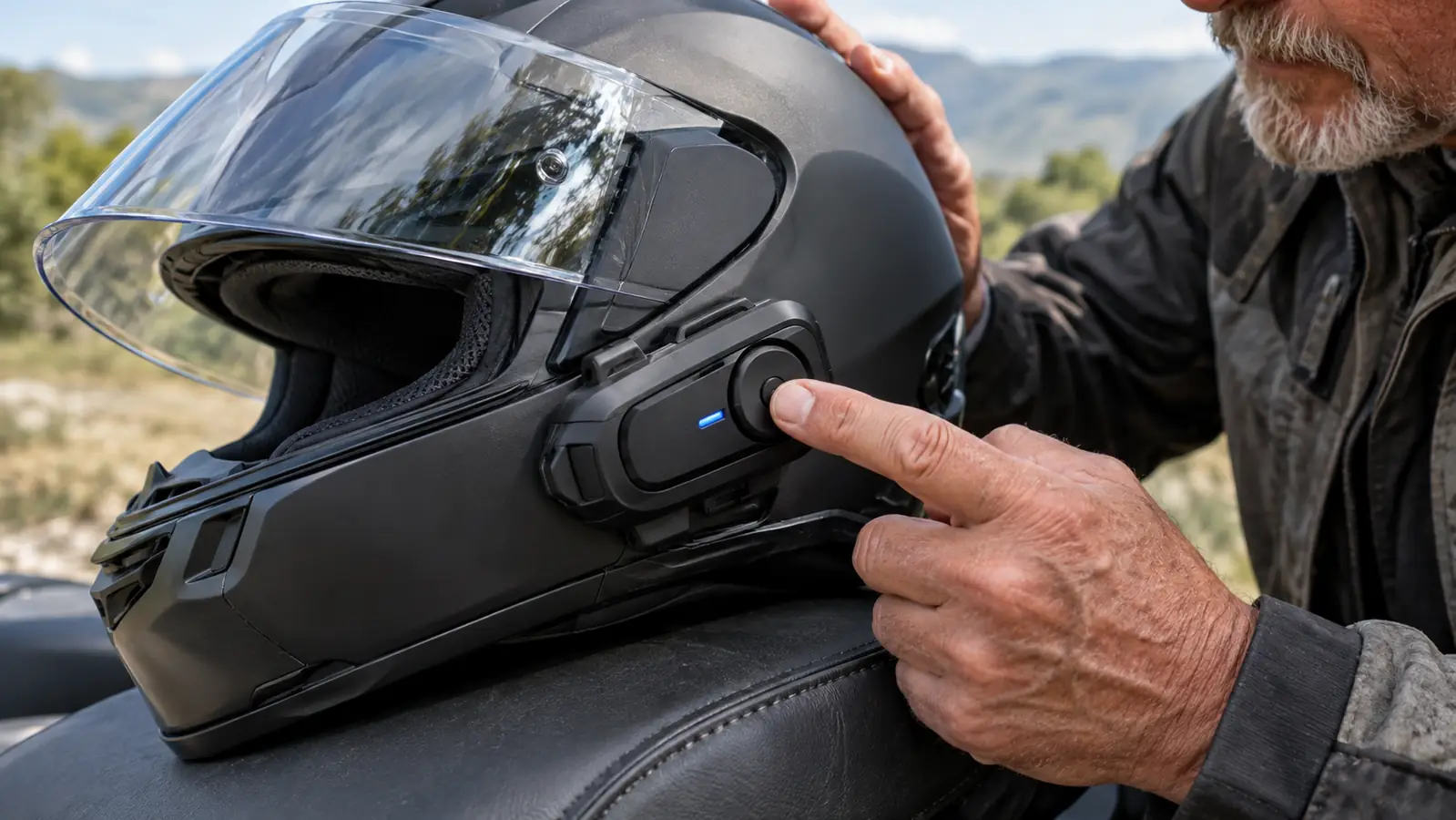
I mounted the Cardo Spirit on my Shoei full-face and left it there. That is the first thing to know: this is not a unit you swap between helmets easily. The clamp is solid once it is on, but it takes a few minutes to install and a little patience to get the speakers positioned over your ears. I did it once and never touched it again.
The install took me about twenty minutes the first time, mostly because I was being careful. The clamp sandwiches the helmet shell between a padded plate inside and the unit outside, and you tighten a small screw until it seats. On the Shoei, the shell is thick enough that I had to find the right spot before tightening, otherwise the clamp sat proud of the helmet and looked like it would catch the wind. Once I had it seated, I ran the speaker wires under the liner and velcroed the pads to the inside. The speakers are thin enough that I do not notice them after the first few minutes, which surprised me. I expected pressure points on a long day.
My routine is about 40 miles of commuting a few days a week, plus longer loops through the Cascades on weekends. That works out to maybe 150 miles a week. The battery handles that with room to spare. I charge it about every five or six days, and I have never had it die mid-ride. One Tuesday in July I did a 200-mile loop east of Bend into the Ochoco foothills and back. Music ran the whole way, two calls from Linda, and the battery indicator still showed full when I pulled into the garage at dinnertime. That is the kind of day that tells you the spec sheet is not lying.
The controls took me a ride or two to learn. The main button handles power and pairing, and the volume rocker sits where my gloved thumb finds it without hunting. After a week I could adjust volume without looking, which matters more than the specs suggest.
Sound Quality: The Part Nobody Reviews Honestly
Here is what nobody tells you: the Cardo Spirit sounds good for a helmet speaker, not good like a set of earbuds. At 70 mph on the Gold Wing, wind noise is the real enemy. The Spirit gets loud enough to hear music and directions clearly, but you will still hear the wind. That is physics, not a flaw.
The speakers sit against your ears through the helmet liner. If they are not positioned right, the sound is thin and distant. Take the extra five minutes to adjust the Velcro pads. It makes a bigger difference than any equalizer setting. On my first ride, I had the left speaker a half inch too far back. Music sounded like it was coming from the next county. I pulled over at a gas station, peeled the liner back, moved the pad forward, and the difference was night and day. If the sound seems off, check the speakers before you blame the unit.
Wind noise changes everything above about 55 mph. At town speeds, the Spirit sounds genuinely good. At freeway speeds, you are listening through a curtain of wind. I have found that a windscreen helps as much as anything. On the Gold Wing, the stock screen tucks me into clean air, and at 70 mph I can hold a conversation with Linda at a normal speaking voice. On a naked bike, I suspect the experience would be worse. That is not a Cardo problem, but it is part of the honest picture.
Phone calls are where the Cardo Spirit surprised me. Linda says I sound like I am in the kitchen, not on a motorcycle. The microphone does a solid job of filtering wind noise, and callers stop asking where I am. The first time she called me from the grocery store while I was on the highway, she asked if I was still in the garage. I told her I was doing 65 on the Bend parkway. She did not believe me until I sent her a photo at the next light. Music is more of a mixed bag. Podcasts and audiobooks come through clearly, and classic rock is fine, but the speakers do not do much with bass. If you want to feel the kick drum, you will want earbuds or a higher-end unit.
Linda says I sound like I am in the kitchen, not on a motorcycle. She did not believe I was doing 65 on the highway.
Battery Life: What the Spec Sheet Doesn't Say
Cardo claims 13 hours of talk time. I have not measured it with a stopwatch, but I have done a full day of riding with music and intercom running and still had battery left at the end. For my riding, that is more than enough. The longest single day I have logged with the Spirit was a July loop from Bend down to Crater Lake and back, about 300 miles and close to eight hours in the saddle. Music ran most of the day, Linda and I talked over the intercom on the approach to the park, and when I pulled into the driveway the indicator still showed half. That matches the claim about as well as I could ask.
The charging port is a magnetic clip that snaps onto the bottom of the unit. It is easy to use with gloves on, which is more than I can say for some micro-USB ports I have fought with. A full charge takes a couple of hours, and I usually top it off while the bike is in the garage overnight. The magnet is strong enough that you can set the clip on the tank and let it snap on without fiddling. I have dropped the clip twice and it survived both times, which tells me the cable end is built better than most.
One honest complaint: the battery indicator is not precise. It shows full, then half, then low, with not much in between. I have learned to charge it when it hits half, because I do not want to find out where the bottom is on a mountain pass. There have been two times when I forgot to charge overnight, headed out with the indicator showing half, and made it through a full commute without it dropping to low. That tells me half is a conservative reading, but I still do not push it.
Cold weather is worth a note. I rode through January and February this year, and the battery drained a little faster in the cold. Nothing dramatic, maybe a day shorter between charges. If you ride in winter, plan to charge every four or five days instead of every six. The unit itself never complained about the cold.
Setup and Pairing: Easier Than I Expected
I am a retired heavy-equipment mechanic, not a software guy. If pairing had been a fight, this review would sound different. The Cardo Spirit paired with my phone in about two minutes, and it reconnects automatically every time I turn it on. That consistency is the feature I value most. I turn the unit on, buckle my helmet, and by the time I am reaching for the ignition the phone is already connected. No waiting, no re-pairing, no digging through settings.
The Cardo app walks you through the settings, but you do not need it for basic use. I set the voice prompts to a lower volume and left everything else alone. The unit remembers the last paired phone and connects before I finish buckling my helmet. The app is useful for one thing: updating the firmware. I updated mine the day I installed it and again in the fall, and both updates were painless. The unit did its restart dance and came back with the same settings.
Pairing with Linda's phone for the intercom took a little longer, mostly because the manual is not written for a guy with reading glasses. The process is: put both units in pairing mode, tap the button on each, and wait for them to find each other. It took us three tries because I kept holding the button too long and putting the unit back into phone pairing mode instead of intercom mode. Once it was done, it stayed done. We have not had to re-pair in six months. The intercom connects automatically when we are both on the bike, and it drops cleanly when we shut down.
One thing the manual does not emphasize: the unit announces its status through the speakers, not through a screen. You hear 'phone connected' and 'battery low' in a calm voice. That voice is loud enough to hear at speed, but I still set it a notch lower because it interrupted the music more than I liked. You can adjust it in the app or by holding the volume rocker during the prompt. I figured that out by accident on the third day.
What Nobody Tells You About the Cardo Spirit
The first thing nobody tells you is that the speakers are the weak link. They are fine, but they are not premium. If you are the kind of rider who notices the difference between budget speakers and premium ones, you will notice here. The Cardo Spirit is built around communication, not audiophile sound.
The second thing is the clamp. It is secure, but it is not universal. On my Shoei it fits perfectly. On a friend's modular helmet it sat at an awkward angle and took some shimming with the included pads. If you have an unusual helmet, check the fit before you commit. The clamp does not damage the shell, which was my first worry. The padded plate distributes the pressure, and after six months of daily use, there is no mark on the helmet.
The third thing is the wind noise on the microphone. The Spirit does a good job, but not a perfect job. At freeway speeds, the person on the other end will hear some wind. It is better than most units I have tried, but it is not noise-canceling headset quality. If you call someone who is not used to riders, they may ask 'are you on the highway?' The answer is yes, and the wind is part of the deal. The fourth thing is the button placement. The main button is easy to hit by accident when you take the helmet off or put it on. I have triggered the voice assistant twice that way. It is a minor annoyance, and you learn to grab the helmet by the chin bar instead. It is the kind of thing that only shows up after you have lived with the unit for a while.
The fifth thing, and this one matters if you ride two-up: the intercom is designed for close range, and for a passenger on the same bike it is rock solid. Linda and I can talk at highway speed without raising our voices. The unit does not have the long-range mesh networking that the higher-end Cardo models have, so if you ride in a group spread out over miles, the Spirit is not the tool for that job.
What I Liked
- Clear intercom and phone calls at highway speed
- Battery easily lasts a week of daily commutes
- Simple pairing that reconnects automatically
- Magnetic charging clip works with gloves on
- Solid build quality
Where It Falls Short
- Speakers are decent, not premium
- Battery indicator only shows full, half, and low
- Clamp fit varies by helmet brand
- Wind noise still gets through at freeway speeds
Who This Is For
The Cardo Spirit is for the rider who wants to hear directions, take a call from home, and talk to a passenger without wrestling with a phone while riding. It is for the rider who wants something that works the first time and keeps working. If that sounds like you, this is the unit to buy.
In my case, that is a 58-year-old who commutes into Bend a few days a week and takes Linda on long loops through the Cascades. I do not need to talk to a group of riders across three counties. I need to hear the GPS tell me where the construction is, take a call from Linda without pulling over, and have a conversation while we are rolling. The Cardo Spirit does those three things every single ride.
Who Should Skip It
Skip the Cardo Spirit if you want premium audio for music. Skip it if you need to pair with multiple riders on group rides, because the Spirit is built for one-to-one intercom, not a group mesh network. And skip it if you have a helmet with an unusual shell shape, because the clamp fit is the one thing I would check before buying.
If you ride with a group every weekend and need to hear five other riders at once, look at a unit with mesh networking. If you wear earbuds under your helmet and want audiophile sound, the Spirit will feel like a step down. And if you have a helmet with a very thin shell or a lot of vents along the side, the clamp may not seat the way it does on my Shoei. None of those are failures of the Spirit. They are honest limits on who should buy it.
Still the unit I reach for after 4,000 miles
The Cardo Spirit is not the fanciest communicator on the market. It is the one that works. If you want clear calls, simple controls, and a battery that keeps up, this is the honest buy.
Amazon Check Today's Price on Amazon →