My wife Linda and I do most of our riding two-up on the Gold Wing. For years that meant hand signals, a lot of shoulder patting, and shouting into the wind at 70 mph. Neither of us could hear the other, and after a full day in the saddle we were both guessing at what the other had actually said. I bought the Cardo Spirit last spring specifically to fix that, and after six months and roughly 4,000 miles of two-up touring, I have a clear picture of what this headset does well and where it comes up short.
The short version: the Cardo Spirit is the best budget-friendly way I have found to get clear rider-to-pillion communication, and it has held up through rain, heat, and a 1,200-mile trip through the Cascades. It is not the loudest or longest-range unit Cardo makes, and riders who need to talk bike-to-bike at highway speeds will want to look higher in the lineup. But for the most common touring setup, a rider and a passenger on the same machine, it does the job every single ride.
The Quick Verdict
The Cardo Spirit is the communicator I recommend to any couple who rides two-up and wants clear, reliable intercom without spending flagship money. It is not the loudest or longest-range unit Cardo makes, but for rider-to-pillion it has been flawless for me.
Amazon Check Today's Price →Talking to your passenger should be this easy
After 4,000 miles of two-up riding, the Cardo Spirit is the headset I keep on my helmet. Clear intercom, simple controls, and it has never left us stranded mid-ride.
Amazon Check Today's Price on Amazon →How I've Used It
I mounted the Cardo Spirit on my Shoei and Linda runs the same unit on her helmet. Our setup is simple: we pair the two headsets to each other, not to our phones, and we use the intercom for the whole ride. That is the use case I care about most, because it is the one that was broken before. We also use the Bluetooth to stream music from my phone on longer trips, and I have taken a handful of phone calls through it when I was riding solo into town.
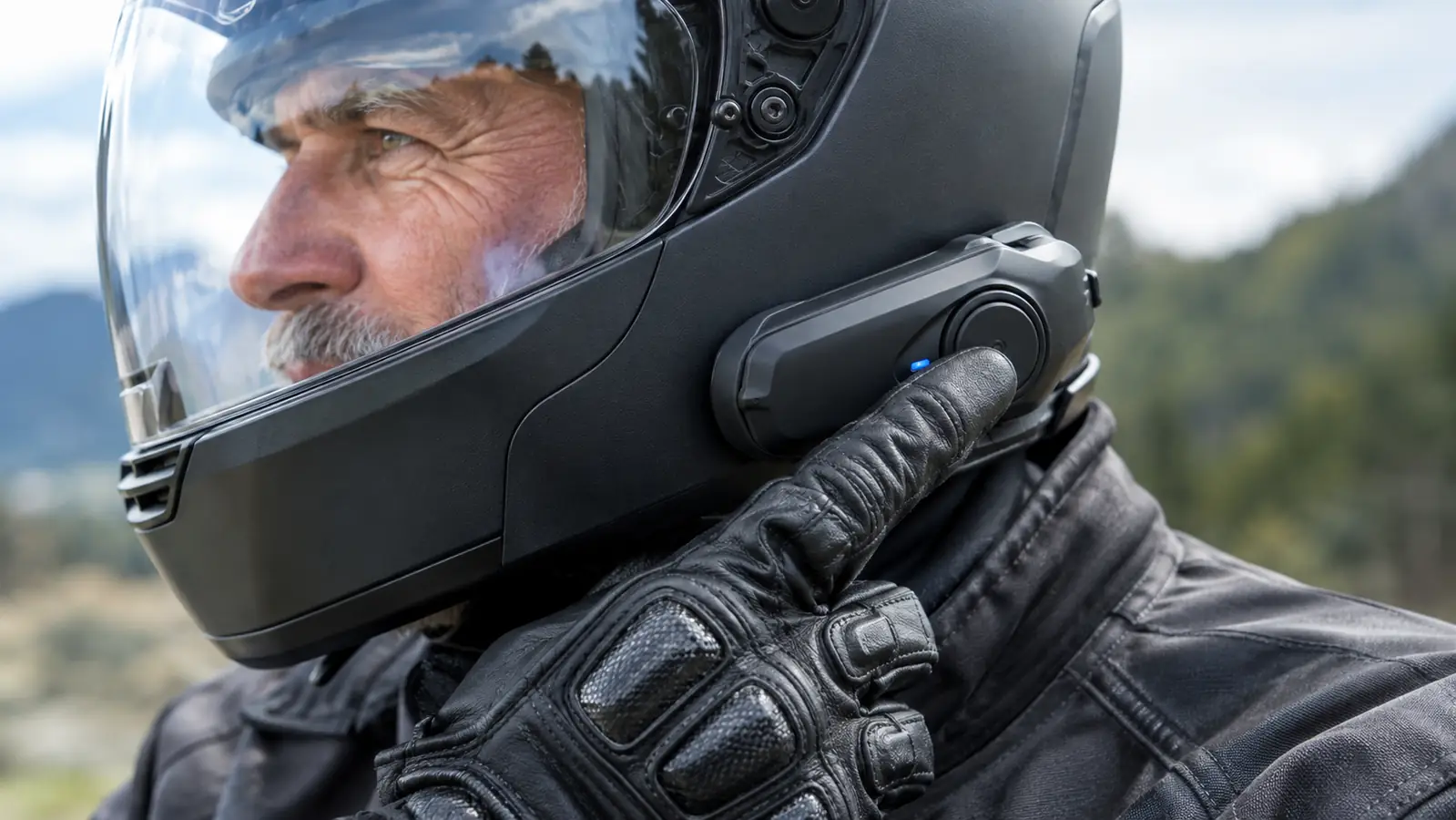
I installed mine on a Tuesday evening in early May. The clamp has two rubber pads that wrap the helmet shell, and the bracket clicks into place with a satisfying snap. I ran the speaker wires under the liner, which on my Shoei means lifting the cheek pads and tucking the cables into the existing channels. The whole job took about ten minutes, and I have not touched it since. The microphone boom is flexible, so I bent it to sit just at the corner of my mouth, and Linda did the same on her helmet. Neither of us has needed to adjust it since.
Our typical ride is a full day: leave Bend in the morning, run a couple hundred miles of highway and mountain pass, stop for lunch, and ride home. That means the intercom is on for six to eight hours at a stretch. I have never had the battery die on a ride, and I charge both units about once a week when we are riding regularly. On the days I commute into town alone, I leave the unit on the helmet and do not even think about it. The standby time is good enough that I have accidentally left a unit on overnight and still had plenty of charge the next morning.
The first real test was a Saturday in mid-May, a 300-mile loop up US 97 to Madras and back through Sisters. Linda and I had been using the headsets for a week, mostly short runs around town, and I was still half expecting the intercom to drop the first time we hit highway speeds. It did not. We talked the whole way up, stopped for a burger in Madras, and talked the whole way back. That was the ride that convinced me the money was well spent.
Intercom Quality at Speed
The reason I bought the Cardo Spirit was to hear Linda, and that is where it has impressed me most. At 70 mph on the Gold Wing, with the windshield up, her voice comes through clearly. I do not have to ask her to repeat herself, and she says the same about hearing me. Wind noise is still there underneath, but it does not drown out the conversation the way it did when we were shouting through the air.
The stretch of US 97 north of Bend is a good test, because the road is straight, the speeds are legal at 65, and the wind off the high desert is constant. We ran that section at 70 mph and talked about nothing in particular for an hour. The intercom works with the push of a button or with voice activation, and I have used both. I tend to tap the button out of habit, but the voice trigger has caught me mid-sentence more than once and connected without me touching anything.
Cardo rates the Spirit for rider-to-passenger communication, and that is exactly the range it delivers. On the rare occasions we have been separated, like when I pulled into a gas station and she stayed with the bike, the connection held until I was a good distance away. I have not had a single dropout in six months of two-up riding. That consistency matters more to me than a spec sheet number, because a headset that drops mid-sentence is worse than no headset at all.
The only time I have heard any crackle was on McKenzie Pass, where the road winds through lava fields and the line of sight is blocked by rock walls for a few seconds at a time. Even then the connection recovered on its own, and we were never cut off for more than a heartbeat. On open roads, the range has been a non-issue. I have walked maybe forty feet from the bike with my helmet on and Linda was still coming through clear, which is more than the rider-to-pillion job requires. One thing I learned: the microphone picks up wind if the boom is not positioned right. The first week, Linda kept telling me I sounded like I was talking through a fan. I slid the boom a quarter inch closer to my mouth and the complaint disappeared. That is the kind of setup detail that matters more than any spec.
At 70 mph with the windshield up, Linda's voice comes through clearly. I do not have to ask her to repeat herself, and that was the whole point of buying it.
Battery Life and Charging
Cardo claims up to 13 hours of talk time on the Spirit, and my real-world number is close to that. On our longest day, a 450-mile loop through the Cascades with the intercom on for nearly nine hours, both units still showed charge at the end of the ride. I have never come close to running one dead, and I am not careful about charging them. They just get plugged in when we get home.
That 450-mile day was the July trip over Santiam Pass and down to the McKenzie River, with a long lunch stop in Sisters. We left at 7 in the morning and pulled into the driveway just after dark. The intercom was on for almost the entire ride, including the slow stretches through construction on Highway 20. When I checked the units that night, both showed more than half battery. Cardo's 13-hour number is not marketing, at least not in my experience.
The charging port is a standard USB-C on the bottom of the unit, which is the right call. I can top either unit off with the same cable I use for my phone, and a full charge from empty takes a couple of hours. The magnetic mount keeps the unit secure on the helmet, and I have never had one come loose, even in the kind of rain that makes you pull over and wait it out.
I keep a spare USB-C cable in the Gold Wing's trunk, so topping off is a two-minute job at a gas stop if we are ever low. The port cover is a small rubber flap, and I make a point of seating it every time I unplug. I have ridden through two real downpours this year, the kind where the rain is coming down hard enough that you can feel it through your jacket, and the units never blinked.
Weather and Build Quality
Central Oregon weather is not gentle on gear. We have ridden through sudden mountain showers, 90-degree heat in the high desert, and the kind of wind that makes you lean into the bike. The Cardo Spirit has taken all of it without a hiccup. The buttons still click the same, the speakers have not distorted, and the unit has never given me a warning about moisture. I keep the charging port cover seated when I am not charging, and that has been enough.
The worst day was an afternoon in August when a thunderstorm rolled over the Cascades and we got caught on the east side of Santiam Pass. The temperature dropped twenty degrees in as many minutes, and the rain came down hard enough that I pulled into a gas station canopy and waited it out. The headsets were soaked. When the rain let up and we got moving again, both units powered on like nothing had happened.
The build feels solid for the price. The plastic is not flimsy, the clamp is tight, and the whole unit has a low profile on the side of the helmet. It is not as sleek as the higher-end Cardo models, but it does not look out of place either. After six months of daily use and one long trip, it still looks and works like the day I installed it.
The buttons have a positive click that works with riding gloves on, which is something I have come to appreciate. My winter gloves are thick enough that I was worried I would not be able to feel the controls, but the main button is raised and easy to find without looking. The volume rocker on the side is the same. After a few rides I could adjust the volume without taking my eyes off the road.
What I'd Change
No piece of gear is perfect, and the Cardo Spirit has two honest weaknesses. The first is speaker volume at the very top end. It is loud enough for me at 70 mph, but riders with significant hearing loss or who ride with earplugs may find themselves wishing for more headroom. I ride with earplugs on long highway stretches and I can still hear Linda, but I have the volume near max when I do.
I wear foam earplugs on any ride that will be more than an hour on the highway, because the wind noise alone is enough to fatigue you by the end of the day. With the earplugs in and the Spirit at full volume, Linda's voice is clear but not loud. It works, but there is no headroom left. If I did not wear earplugs, I would not even think about it. Riders who already struggle to hear conversation at home should probably look at the louder models.
The second is the range for bike-to-bike use. Cardo does not position the Spirit as a long-range unit, and it is not one. If Linda and I were riding separate bikes, I would want the stronger mesh system from Cardo's higher-end line. For two-up touring, the range is a non-issue. But it is worth knowing before you buy, because riders who want to talk to friends on other bikes will be disappointed.
I tested this once with a friend who also has a Spirit, just to see what the bike-to-bike range actually is on open road. We stayed connected until we were maybe a quarter mile apart, and then the audio started to break up and cut out. For two riders on the same machine, that number does not matter at all. For a group ride with bikes spread out across a few miles of highway, it absolutely does. If group riding is your plan, buy a mesh unit instead.
What I Liked
- Clear rider-to-pillion intercom at highway speeds
- Simple one-button pairing that has never dropped mid-ride
- Battery life that easily covers a full day of touring
- USB-C charging with a standard cable
- Solid weather resistance through rain and heat
- Easy clamp-on installation with no tools
Where It Falls Short
- Speaker volume tops out lower than pricier Cardo models
- Bike-to-bike range is limited, not meant for group rides
- No mesh intercom, so pairing is one-to-one only
- Music and phone audio sound fine but not premium
Who This Is For
The Cardo Spirit is for the rider who wants to talk to the person on the back of the bike. If you ride two-up most of the time, if you are tired of hand signals and shoulder pats, and if you do not need to chat with a whole group of riders on other machines, this is the headset to buy. It is also a great first communicator because the installation is simple and the controls are genuinely easy to learn. Linda, who is not interested in fiddling with electronics, had no trouble using it from the first ride.
The controls are simple enough that she figured them out before I finished explaining them. The main button turns the unit on and starts the intercom, and the volume rocker does what you expect. There is no app you need to open, no settings to fuss with. For riders who want a communicator that just works, that simplicity is the point.
Who Should Skip It
Skip the Cardo Spirit if you ride in a group and need to talk to riders on other bikes at highway speeds. The range just is not there, and you will be frustrated. Skip it too if you want the loudest possible speakers or the most premium audio for music. The Spirit sounds good, but it is not an audiophile device. And if you already own a higher-end Cardo with mesh intercom, the Spirit is a step down in features, not an upgrade. For those riders, the money is better spent on the next model up.
Give your passenger a voice on the next ride
Six months of two-up touring with the Cardo Spirit and I have not once wished I had spent more. If you ride with a partner, this is the upgrade that changes every trip.
Amazon Check Today's Price on Amazon →